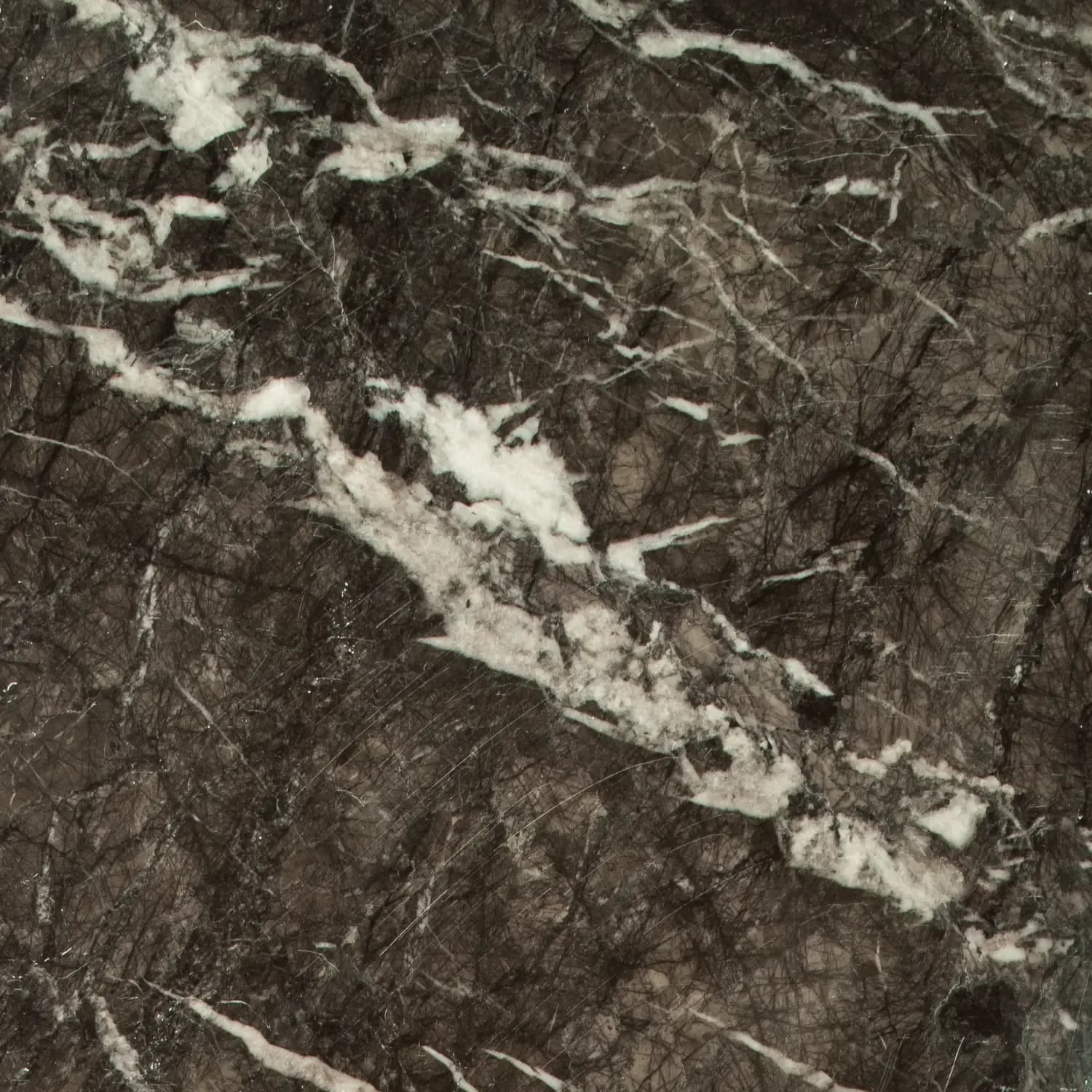
Every palette needs a dark stone, and Grigio Carnico is one of the best. It is a deep grey to grey-black Italian marble crossed by fine white veining, and the effect is dramatic without being cold: rich, deep, and full of movement where the pale veins cut across the dark ground. It is the marble you reach for when a scheme needs weight and contrast, a floor with gravity, or a feature surface that commands a room.
We publish Grigio Carnico and source it at the block, so here is the specifier's guide: what it is, the honest technical picture, how to finish it, and where a dark marble like this genuinely belongs.
What Grigio Carnico is
Grigio Carnico is a marble from the Carnia area of the Friuli-Venezia Giulia region in north-east Italy, near the Carnic Alps that give it its name. It is a metamorphic limestone, recrystallised into marble, with a dark grey to nearly black background and a network of fine white and pale grey veins running through it.
That contrast is its signature. The dark ground gives depth and drama, and the white veining gives movement and light, so the stone reads as rich and alive rather than flat. It carries the sophistication of a classic dark Italian marble, in the tradition of the great grey and black stones that have furnished European interiors for centuries.
Character and why it appeals
Dark marble does something no pale stone can: it grounds and dramatises a space at once. A Grigio Carnico floor gives a room a sense of depth and luxury; a Grigio Carnico feature wall or reception desk becomes the focal point without any other intervention. The white veining keeps it from feeling heavy, threading light through the dark and rewarding close viewing.
There is a practical side to the drama too. Dark stone hides foot-borne dirt and everyday marks far better than pale marble or limestone, which makes Grigio Carnico genuinely forgiving in high-traffic and commercial settings, not just beautiful.
Technical properties
Grigio Carnico is a marble, with the behaviour that implies, and the specific block governs the exact numbers.
Hardness and density. A sound marble, suitable for flooring and cladding when specified and finished correctly. Being calcite-based, it etches with acid and scratches under abuse like all marble.
Water absorption. Low, typical of dense marble, but sealing is still standard on floors and wet areas to manage staining.
Veining and consistency. The intensity and pattern of the white veining varies across the block, so the drama of the material is part of what you select. Sample and, ideally, view the actual slabs.
Reserve from a known block and specify to tested numbers. With a dramatic veined marble, block and slab selection also drives the look.
Finishes and where they belong
Honed is the sensible default for floors and high-traffic surfaces: it wears gracefully, grips better underfoot, hides micro-scratching, and disguises the etching calcite marble inevitably suffers. It gives the dark ground a deep matte richness.
Polished deepens the black and sharpens the white veining to maximum drama, which is spectacular on low-traffic feature walls, reception faces, and vertical surfaces where no one walks and nothing acidic lands. On a busy floor, polish abrades into a dull path.
Brushed or leathered gives a tactile, contemporary matte surface that suits worktops and vanities and hides marks well.
Match the finish to the traffic. Polished for the feature, honed for the floor.
Where Grigio Carnico belongs
Indoors is where this marble lives. It makes dramatic, dirt-forgiving floors, commanding feature walls, luxurious reception faces, striking vanity and counter tops, and rich detailing. It is a natural counterpoint to pale stones such as Carrara White, the light-and-dark pairing that has anchored elegant interiors for centuries, and it appears in our hotel lobby flooring guide as a rich, dirt-forgiving dark floor for hospitality.
Outdoors, like other calcite marbles, Grigio Carnico is generally not the right choice; it weathers and stains in exposed conditions. For facades and paving, specify a dense limestone or a hard sandstone instead, as set out in our exterior cladding guide.
Sampling Grigio Carnico
Because the veining varies and dark marble reads so differently in different light and finishes, Grigio Carnico is a stone to specify from actual slabs or reserved material, viewed in your intended finish and the real light of the space. A polished sample overstates the drama of a honed floor, so always sample in the finish you will build.
If you are specifying Grigio Carnico, or building a light-and-dark scheme with it, start a project brief and we will source the block, slab selection, and finish that suit your application, with honest guidance on honed versus polished and on maintenance. Or request samples in the finish you are considering and see the real material before you commit.